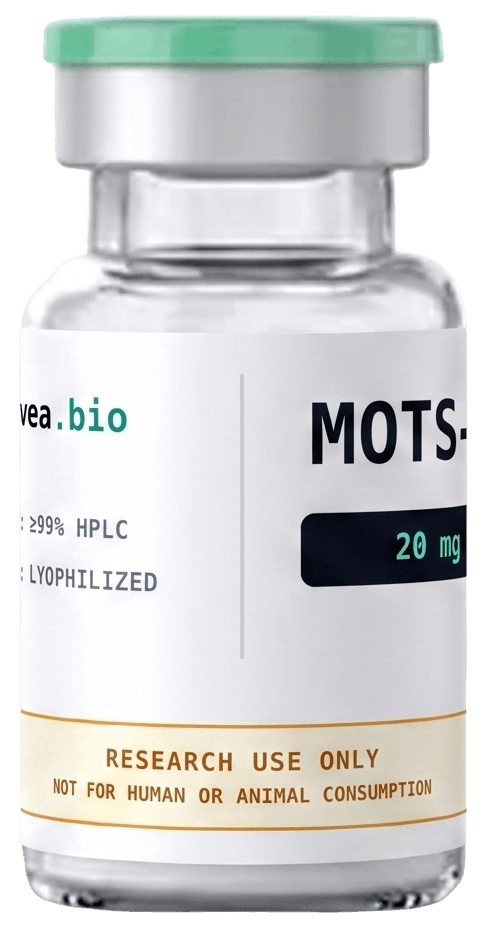
MOTS-c
MOTS-c (Mitochondrial ORF of the 12S rRNA type-c)
- ≥99% HPLC
- LC-MS Verified
- Tested
- Vacuum-Sealed
- Cold-Chain Ready
A peptide written into the mitochondrial genome that acts as a metabolic regulator, relevant to the energy stress retinal tissue experiences. It is used in metabolic assays to study glucose uptake, cellular insulin sensitivity, and physical performance improvement.
16 residues · teal = non-canonical / D-isomer · descriptive schematic
Relevance to Vision Research
Retinal metabolic stress is a recurring theme in vision research, and MOTS-c is studied as a mitochondrial-derived regulator of metabolic homeostasis. Direct ocular data is more limited and is noted as such.
Where It Acts : Pathway Map
2 structures targetedAn animated map of the visual pathway, from the eye through the brain to the systemic processes of aging. Highlighted nodes mark the structures MOTS-c is studied against.
Illustrative research map : highlighted structures reflect the published in-vitro / preclinical literature, not human outcomes.
Key Performance Benefits
Scientifically supported advantages for peak performance and recovery.
Exercise-Mimetic & AMPK Activation
Activates the AMPKα pathway, mimicking the metabolic and physiological benefits of physical exercise at the cellular level.
Optimizes Glucose & Lipid Metabolism
Enhances insulin sensitivity and glucose clearance, promoting metabolic homeostasis and cellular fat loss.
Drives Mitochondrial Biogenesis
Promotes the creation of new mitochondria, amplifying physical endurance and systemic energy capacity.
Disclaimer: MOTS-c should be used responsibly. These statements have not been evaluated by the FDA. Not intended to diagnose, treat, cure, or prevent any disease.
What the Research Shows
1 references ↓Regulates metabolic stress[1]
Studied in the metabolic stress implicated in retinal energy failure (direct ocular data limited).
Exercise-mimetic research[1]
Investigated for reproducing some of the metabolic effects of physical exercise.
Mitochondrial-derived peptide[1]
Encoded in mitochondrial DNA; circulating levels are reported to fall with age.
Summaries of observations reported in published in-vitro and preclinical research. These are research-model findings, not established human outcomes, and not claims of benefit, safety, or efficacy. Supplied for laboratory research use only.
Literature Protocol Reference
Preclinical and clinical trial parameters documented in published literature. Reconstituted reference materials are designed for laboratory analysis and in-vitro assays.
Research Literature Notes
Standard dosage is 5 mg to 10 mg administered three times weekly. Refrain from daily administration to prevent potential AMPKα desensitization. Can be mixed with SS-31 in the same syringe. Maximum of 3 to 4 cycles per year.
Why It Is Used
At 16 residues MOTS-c is the largest and most conformationally complex material in the catalogue, with sulfur-bearing residues that warrant attention to oxidation during handling. It is reasonably water-soluble though sonication aids dissolution. Its size and basic-residue content make it the most demanding identity confirmation in the set; HPLC purity is specified at ≥99%.
Objective structural / physicochemical opinion. Not medical advice.
Related Scientific Reports
Read the full literature review on MOTS-cMOTS-c and the Retinal Microenvironment: Metabolic Coordination of Cellular Response under HEV Stress
A systematic literature review exploring the mitochondrial-derived peptide MOTS-c, its cellular uptake, and reported pathways modulating metabolic homeostasis, AMPK activation, and cell survival under high-energy visible (HEV) photo-oxidative stress. Surveyed purely as reference literature; no clinical outcomes are claimed.
All-Atom Conformational Ensemble of MOTS-c against Mitochondrial Complexes I and IV under Simulated HEV Stress
An in-silico structural modeling study predicting the docking topology and dynamic interface of the mitochondrial-derived peptide MOTS-c against active subunits of Mitochondrial Complexes I and IV. Electrostatic persistence and relative free energies of binding were calculated across conformer ensembles.
Documented References
- [1]
Lee C, et al. (2015) The mitochondrial-derived peptide MOTS-c promotes metabolic homeostasis and reduces obesity and insulin resistance.
Cell Metabolism
View on PubMed
References point to published, third-party scientific literature, provided for research context. Citation of a study is not an endorsement of any use of this material.
Molecular Identity
- CAS Number
- 1627580-64-6
- Molecular Formula
- C₁₀₁H₅₃N₂₅O₂₂S₂
- Molecular Weight
- 2174.5 g/mol
- Sequence
- 16-residue mitochondrial-derived peptide (MRWQEMGYIFYPRKLR)
- Purity
- ≥ 99.0% (HPLC, area)
- Format
- Lyophilized powder, vacuum-sealed vial
Analytical Specification
Research Context
MOTS-c is a 16-amino-acid peptide encoded within the mitochondrial 12S rRNA region, studied in the literature as a regulator of metabolic homeostasis with reported AMPK-pathway interactions in in-vitro and model-organism work. Catalogued here as a sequence-defined peptide reference standard for metabolic-signaling assays.
Laboratory Handling
Soluble in laboratory-grade water; sonication may assist dissolution. In-vitro handling data only.