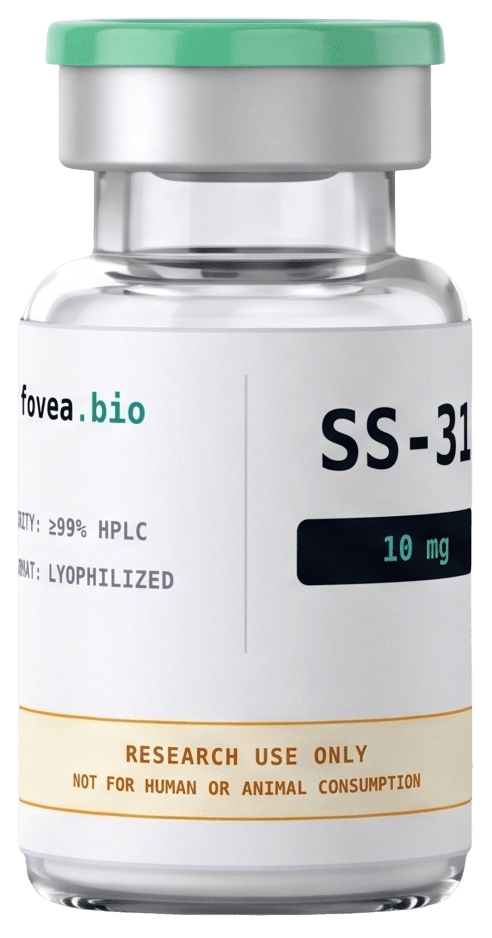
SS-31
SS-31 / Elamipretide (D-Arg-Dmt-Lys-Phe-NH₂)
- ≥99% HPLC
- LC-MS Verified
- Tested
- Vacuum-Sealed
- Cold-Chain Ready
A small peptide that targets cardiolipin, the key lipid inside mitochondria, the energy plants that retinal cells rely on more than almost any other tissue. In laboratory research, it is primarily used to investigate mitochondrial recovery, prevent cellular oxidative stress, and support retinal ganglion cell survival.
4 residues · teal = non-canonical / D-isomer · descriptive schematic
Relevance to Vision Research
Retinal ganglion cells and foveal photoreceptors carry one of the highest mitochondrial densities in the human body. SS-31 is studied in vision research precisely because it concentrates at mitochondrial cardiolipin.
Where It Acts : Pathway Map
10 structures targetedAn animated map of the visual pathway, from the eye through the brain to the systemic processes of aging. Highlighted nodes mark the structures SS-31 is studied against.
Illustrative research map : highlighted structures reflect the published in-vitro / preclinical literature, not human outcomes.
Key Performance Benefits
Scientifically supported advantages for peak performance and recovery.
Stabilizes Cardiolipin & Mitochondria
Directly targets and binds to cardiolipin in the inner mitochondrial membrane, optimizing the electron transport chain and cellular energy production.
Prevents Retinal Ganglion Loss
Provides critical neuroprotection for retinal ganglion cells (RGCs) by preventing structural degradation and protecting retinal pathways.
Suppresses Oxidative Stress
Significantly reduces reactive oxygen species (ROS) leakage and maintains mitochondrial membrane potential (ΔΨm) under metabolic stress.
Disclaimer: SS-31 should be used responsibly. These statements have not been evaluated by the FDA. Not intended to diagnose, treat, cure, or prevent any disease.
What the Research Shows
2 references ↓Studied in macular degeneration[1]
Evaluated in clinical research programmes for dry AMD and geographic atrophy.
Supports retinal cell energy[2]
Reported to protect RGC and photoreceptor mitochondria under stress in preclinical models.
Targets cardiolipin[2]
Binds the inner-membrane lipid cardiolipin and helps stabilize energy production.
Lowers oxidative stress[2]
Studied for reducing reactive-oxygen-species (ROS) leakage from the energy chain.
Counters mitochondrial aging[2]
Investigated for age-related decline in mitochondrial efficiency across tissues.
Summaries of observations reported in published in-vitro and preclinical research. These are research-model findings, not established human outcomes, and not claims of benefit, safety, or efficacy. Supplied for laboratory research use only.
Literature Protocol Reference
Preclinical and clinical trial parameters documented in published literature. Reconstituted reference materials are designed for laboratory analysis and in-vitro assays.
Research Literature Notes
Preclinical models evaluate SS-31 at 5 mg to 10 mg daily. Can be mixed with MOTS-c in the same syringe for co-injection. Do not mix with GHK-Cu or NAD+. Stored solution should be protected from light and kept refrigerated for a maximum of 4 weeks.
Why It Is Used
The alternating aromatic-cationic motif (D-Arg / Dmt / Lys / Phe) gives SS-31 a concentrated positive charge paired with two aromatic faces, a geometry consistent with the electrostatic and stacking contacts observed against anionic cardiolipin head-groups in the in-house bilayer modeling. The D-arginine and amidated C-terminus are notable for peptidase resistance. It is highly water-soluble and well-behaved; the Dmt residue is the key identity marker, verified by MS/MS.
Objective structural / physicochemical opinion. Not medical advice.
Related Scientific Reports
Read the full literature review on SS-31Elamipretide (SS-31) in Retinal Mitochondrial Protection: A Literature Synthesis
A survey of published preclinical and clinical research on the aromatic-cationic tetrapeptide SS-31 (elamipretide) in retinal contexts, including the ReCLAIM programme of AMD and geographic-atrophy clinical trials and preclinical models of traumatic optic neuropathy. Mechanistic emphasis is placed on cardiolipin association and inner-membrane stabilization. Reference survey only; efficacy is not asserted.
Dynamic Association of SS-31 with Cardiolipin and the PLSCR3 Interface in a Model Inner-Membrane Bilayer
A membrane-embedded interaction study modeling the aromatic-cationic tetrapeptide SS-31 against cardiolipin and a PLSCR3 interface model. Association trajectories were sampled and characterized by electrostatic contact persistence and aromatic stacking occupancy. Reported as structural reference data; no physiological effect is asserted.
Photoreceptor Phototoxicity and Antioxidant Peptide Strategies: A Structural Survey
A structural survey of high-energy-visible (HEV) photo-oxidative stress pathways in photoreceptor and RGC mitochondria, mapped against the reported antioxidant and membrane-stabilizing properties of the catalogued short peptides. Combines a literature map with in-house physicochemical descriptors. Reference survey only.
Documented References
- [1]
Mettu PS, Allingham MJ, Cousins SW. (2022) Phase 1 Clinical Trial of Elamipretide in Dry Age-Related Macular Degeneration and Noncentral Geographic Atrophy: ReCLAIM NCGA Study.
Ophthalmology Science
View on PubMed - [2]
Szeto HH. (2014) First-in-class cardiolipin-protective compound as a therapeutic agent to restore mitochondrial bioenergetics.
British Journal of Pharmacology
View on PubMed
References point to published, third-party scientific literature, provided for research context. Citation of a study is not an endorsement of any use of this material.
Molecular Identity
- CAS Number
- 736992-21-5
- Molecular Formula
- C₃₂H₄₉N₉O₅
- Molecular Weight
- 639.79 g/mol
- Sequence
- H-D-Arg-Dmt-Lys-Phe-NH₂ (Dmt = 2,6-dimethyltyrosine)
- Purity
- ≥ 99.0% (HPLC, area)
- Format
- Lyophilized powder, vacuum-sealed vial
Analytical Specification
Research Context
SS-31 (elamipretide) is an aromatic-cationic tetrapeptide widely studied for its association with cardiolipin in the inner mitochondrial membrane and its reported effects on electron-transport-chain organization in in-vitro and preclinical models. It incorporates a non-canonical 2,6-dimethyltyrosine (Dmt) residue. Catalogued here as a peptide reference standard for mitochondrial and phospholipid interaction assays.
Active in-silico track: dynamic association modeling of SS-31 with cardiolipin and the PLSCR3 interface in a model inner-membrane bilayer. Interaction trajectories published, anonymized, as structural reference data only.
Laboratory Handling
Soluble in laboratory-grade water. Solubility and stability data provided for in-vitro membrane assay design only.